Empowering Agents, Accelerating Business
A custom quoting platform concept for Allstate's small-business insurance agents, and the strategic fight to build it in-house instead of buying off-the-shelf software.

This project didn't reach development: Allstate acquired Next Insurance midway through, and priorities moved in-house. I'm including it because the leadership challenge was real: I operated as both lead designer and de facto product manager inside a waterfall org, made the case for a custom build over off-the-shelf software, and pushed the client toward more agile ways of working. The artifacts here shaped how Allstate's team framed the problem going forward.
Agents are the frontline bridge between Allstate and small business owners.
To stay competitive in a crowded market, they need tools that let them:
- ✧ Deliver fast, accurate quotes for small business policies
- ✧ Seamlessly upsell complementary products like home and auto insurance
- ✧ Maintain trust and efficiency in every customer interaction
But the legacy quoting tools weren't built for today's agent workflow. Multiple disconnected systems and outdated screens created friction for new and experienced agents alike.
How might we give insurance agents a single, streamlined quoting portal that saves time, reduces errors, and unlocks new upsell opportunities, while helping Allstate gain a competitive edge in small-business insurance?
One agent-first portal, built around speed, clarity, and upsell.
A comprehensive, end-to-end responsive platform that would give agents unified tools to manage the entire insurance lifecycle, while giving customers real-time access to their quote information during signing.
The redesign targeted four goals:
- ✧ Unify tools into one cohesive quoting experience
- ✧ Cut quoting time from ~20 minutes toward under 10
- ✧ Lower error rates by standardizing data input and validation
- ✧ Accelerate onboarding so new agents are productive in days, not weeks
- ✧ Unlock cross-sell by surfacing auto and home policy options directly inside the small-business quote flow
From discovery to concept screens
Industry Audit & Competitor Analysis
Analyzed trends across insurance and insurtech to identify emerging patterns, customer expectations, and digital experience standards. Benchmarked direct and indirect competitors to identify gaps and gather inspiration for best-in-class agent workflows.


Agent Interviews & Lean Canvas
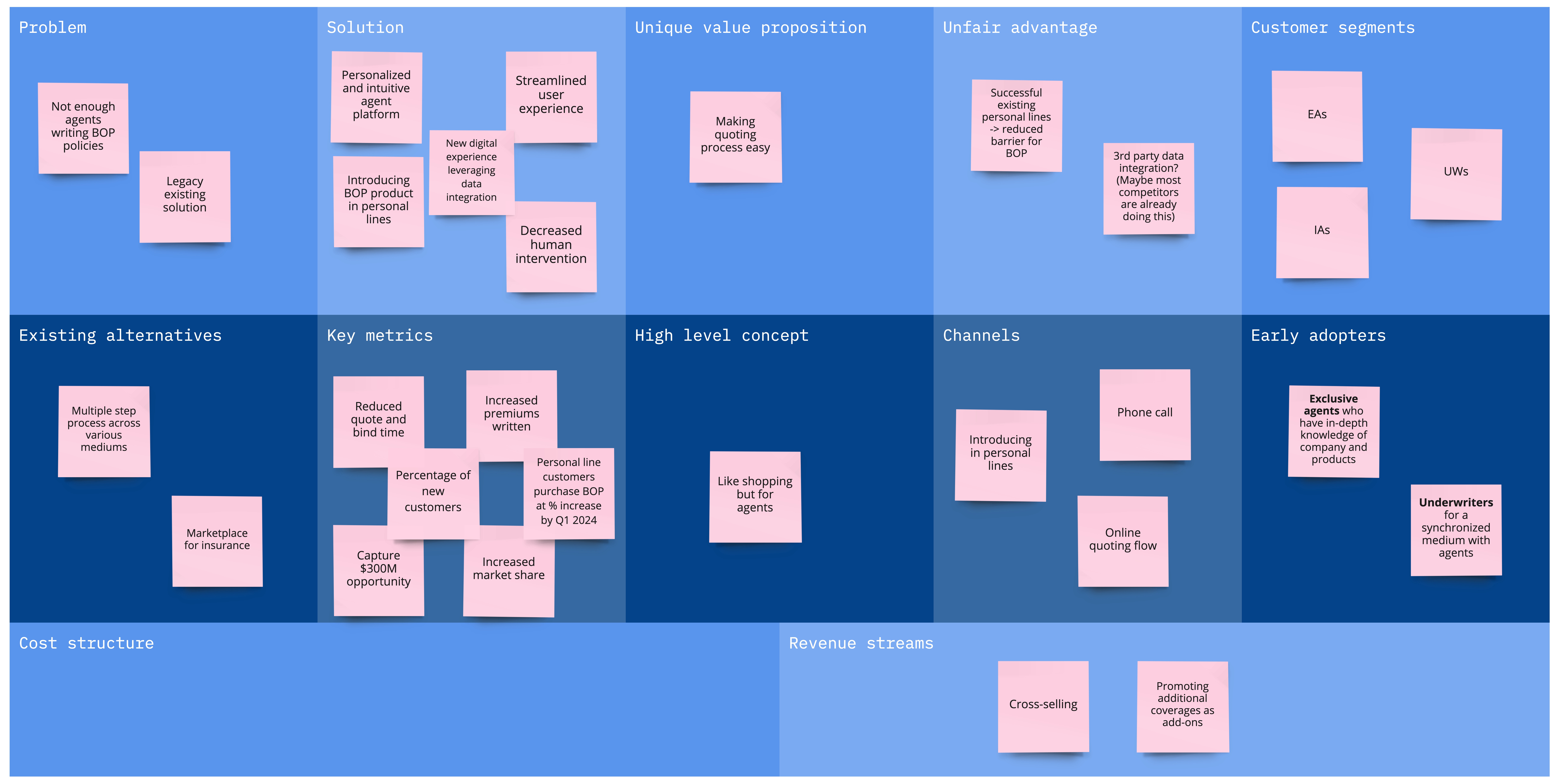
Interviewed 10 Allstate agents, a mix of exclusive and independent agents, to understand how quoting actually happened day-to-day, not just how the legacy system assumed it should. Synthesized the findings into a lean canvas that mapped agent goals, pain points, and workarounds side by side, surfacing exactly where the existing quoting tool broke down most often and where a rebuilt experience could create the most leverage.
System Roles & Decision Flow Diagram
Mapped how different personas interacted with the system, then built a decision flow diagram to capture key workflows and decision points, highlighting friction in quoting, policy servicing, and renewals.

Wireframing
Translated core workflows into low-fidelity wireframes to rapidly iterate on layout, hierarchy, and functionality, focused on streamlining the quoting process, surfacing critical actions, and supporting task efficiency.

High-Fidelity Design
[This currently duplicates the wireframe step: write what actually changed here. E.g.: which visual system or component library you applied, how you resolved data-density problems on the quote comparison screens, what got simplified or cut based on wireframe feedback, how the mobile/responsive views differed from desktop. This is likely where your strongest visuals live, so give it real detail.]
Build vs. buy: why I argued for build
Allstate's default path was off-the-shelf quoting software. I made the case for a custom-built experience instead: a tailored solution could align with agents' actual workflow, create real competitive advantage, and stay flexible enough to scale as the product matured, where off-the-shelf tools would have locked the team into someone else's assumptions about how agents work.
The off-the-shelf vendors we evaluated could handle single-product quoting, but none of them could natively support Allstate's cross-sell logic: surfacing auto and home policy options directly inside a small-business quote flow, in real time, based on what the agent had already entered. They also couldn't integrate cleanly with the 4 to 5 legacy systems agents were already switching between, which meant bolting on another disconnected tool rather than solving the fragmentation. Building custom meant agents got one connected experience instead of a sixth system to learn, and it gave Allstate a data layer it could evolve as the roadmap changed, rather than being locked into a vendor's release cycle and pricing.
The work didn't ship, but it changed how the client framed the problem
I led and produced these recommendations and artifacts as the sole designer on the engagement, with strategic direction shaped collaboratively with the Allstate stakeholder team.
Made the case for a custom-built quoting experience over Allstate's existing out-of-the-box option, and won the argument internally before priorities shifted.
Demonstrated how a tailored solution could create competitive advantage, align with agent workflows, and stay flexible enough to scale over time.
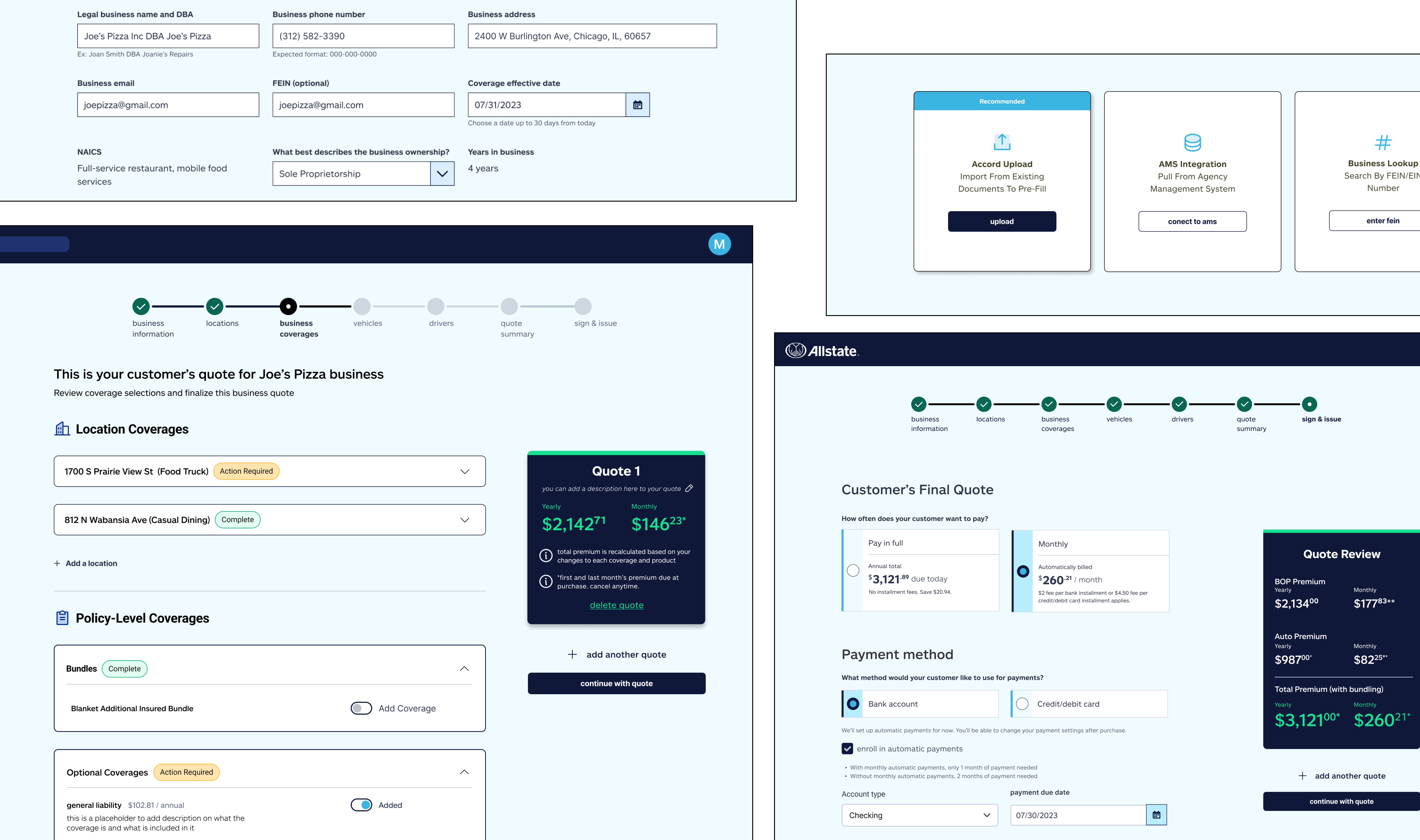
Produced redesigned quoting flows and concept screens showing a modernized, user-centered agent experience.
Development was ultimately redirected in-house after Allstate acquired Next Insurance, so the projected time and error-rate improvements above were never measured in production as a result.
Design leadership beyond the UI
This project unfolded in a heavily waterfall environment, which created both challenges and opportunities. Stepping in as lead designer, I also assumed many product management responsibilities, directing the roadmap, shaping strategy, and guiding the client team toward more agile ways of working. The work didn't continue past this engagement, but it showed how design leadership can extend beyond UI to influence process, strategy, and culture.
Design + product leadership
Taking ownership of roadmap and strategy is often what makes the design succeed.
Educating clients matters
Guiding teams from waterfall toward agile practices unlocks better collaboration and outcomes.
Adaptability
Even when priorities shift, strong artifacts and a clear vision give the work lasting influence.
Design as catalyst
Well-framed concepts can drive conversations about change, even without reaching full implementation.